

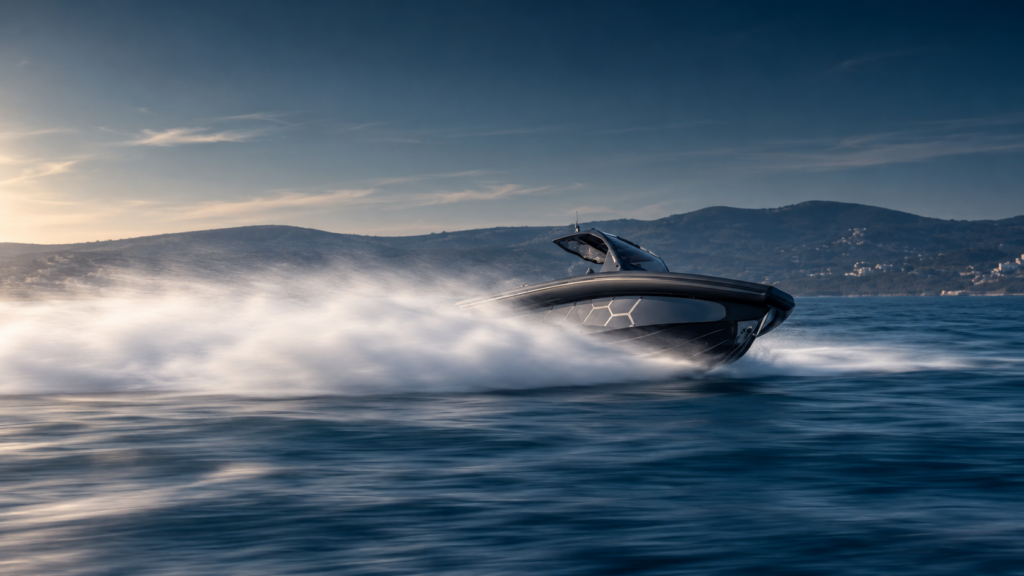
True performance doesn’t begin with the engine. It begins where the hull meets the water.
What makes a high-performance boat truly exceptional? Is it the power of its engines, its top speed or the way it cuts through the waves?
At SKIPPER Powerboats, we believe the answer lies somewhere deeper.
Beneath every exceptional performance experience is a carefully engineered hull — one that determines how efficiently a boat moves, how quickly it gets on plane, how it responds at speed and how confidently it handles the sea.
This is where our engineering philosophy begins.
Developed through advanced hydrodynamic research, precision engineering and continuous testing, the patented AeroQuad® 4-Step Hull Technology represents our approach to transforming power into intelligent performance.
Because more horsepower is only part of the equation. How efficiently you use it makes all the difference.
The science behind the 4 steps
Traditional deep-V hulls are designed to cut through waves and provide offshore capability. However, as speed increases, the surface area of the hull in contact with the water creates friction and hydrodynamic resistance. This is where SKIPPER’s patented AeroQuad 4-Step Hull Technology makes the difference. Instead of relying on one continuous running surface, our engineers have developed a hull incorporating four strategically positioned transverse steps. These steps introduce controlled ventilation beneath the hull, creating air channels that help reduce the wetted surface and hydrodynamic drag. The result is a more efficient relationship between power, lift and resistance.
The 4 Principles Behind AeroQuad
The AeroQuad® technology is built around four interconnected engineering principles. Each contributes to the overall performance of the hull.
01 — Controlled Air Ventilation
The strategically positioned steps introduce air beneath the hull, creating controlled air channels along the running surfaces.
This helps reduce direct water contact and the friction associated with it, allowing the hull to move more efficiently at speed.
02 — Reduced Hydrodynamic Drag
Less wetted surface means less frictional resistance.
By managing the interaction between the hull and the water, AeroQuad® is designed to reduce drag and make more effective use of available engine power.
03 — Optimized Hydrodynamic Lift
The positioning and geometry of the four steps are engineered to distribute lift across the hull’s running surfaces.
This contributes to efficient planing, responsive acceleration and a carefully balanced running attitude.
04 — Control, Stability and Ride Quality
Performance is not simply about how fast a boat can travel. It is equally about how it behaves while doing so.
The combination of step geometry, precision-engineered strakes, chines and carefully developed hull geometry contributes to directional stability, water deflection and a more controlled, comfortable offshore experience.
Together, these elements define the AeroQuad approach to high-performance hull design.
Engineering behind the innovation
The AeroQuad® hull is not simply a modification of a conventional V-hull. It is the result of an integrated design and development process involving:
• Computational Fluid Dynamics (CFD) simulations.
• Hydrodynamic analysis and optimization.
• Advanced step-position and geometry calculations.
• Scale-model testing.
• Full-size prototype development and sea trials.
• Continuous refinement of hull balance and performance.
Every element contributes to the final result. The objective is not simply to achieve higher speed. It is to achieve speed with efficiency, control and confidence. SKIPPER’s published technology specifications identify potential improvements of up to 20% in fuel efficiency, 30% in acceleration and 10% in top speed compared with conventional V-hulls. These are manufacturer-stated comparative figures, not guaranteed results for every model or operating condition.
From Engineering to the Experience at Sea
Technology matters most when its benefits extend beyond the engineering drawings and become part of the owner’s experience.
So, what does AeroQuad actually mean when you are out on the water?
Greater Efficiency
By reducing hydrodynamic resistance and the wetted surface, AeroQuad is designed to make more effective use of engine power, contributing to improved fuel efficiency.
Responsive Acceleration
Optimized hydrodynamic lift supports efficient planing and acceleration, allowing the boat to respond more effectively to throttle input.
Confidence and Control
The combination of four steps, strakes, chines and refined hull geometry is engineered to support balanced handling and controlled performance, even in challenging offshore conditions.
A More Comfortable Ride
Carefully developed hull geometry and water-deflecting surfaces contribute to a drier, more composed cruising experience.
Whether accelerating into open water, cruising along the coastline or navigating challenging offshore conditions, the goal remains the same:
To create a driving experience where speed, comfort and control work together.
At SKIPPER Powerboats, innovation is not an isolated feature added to a boat. It is embedded in the way we approach design, development and performance.
The AeroQuad 4-Step Hull reflects our commitment to challenging conventional thinking and exploring new possibilities in high-performance marine engineering.
Designed and developed in Greece, our boats bring together advanced hydrodynamic engineering, distinctive design and meticulous craftsmanship.
Every detail has a purpose. Every element contributes to the experience.
And while the engines may capture the attention, it is the engineering beneath the waterline that helps define the way a SKIPPER performs.
Because true performance isn’t just about the power you see.
It’s about the engineering you don’t.
